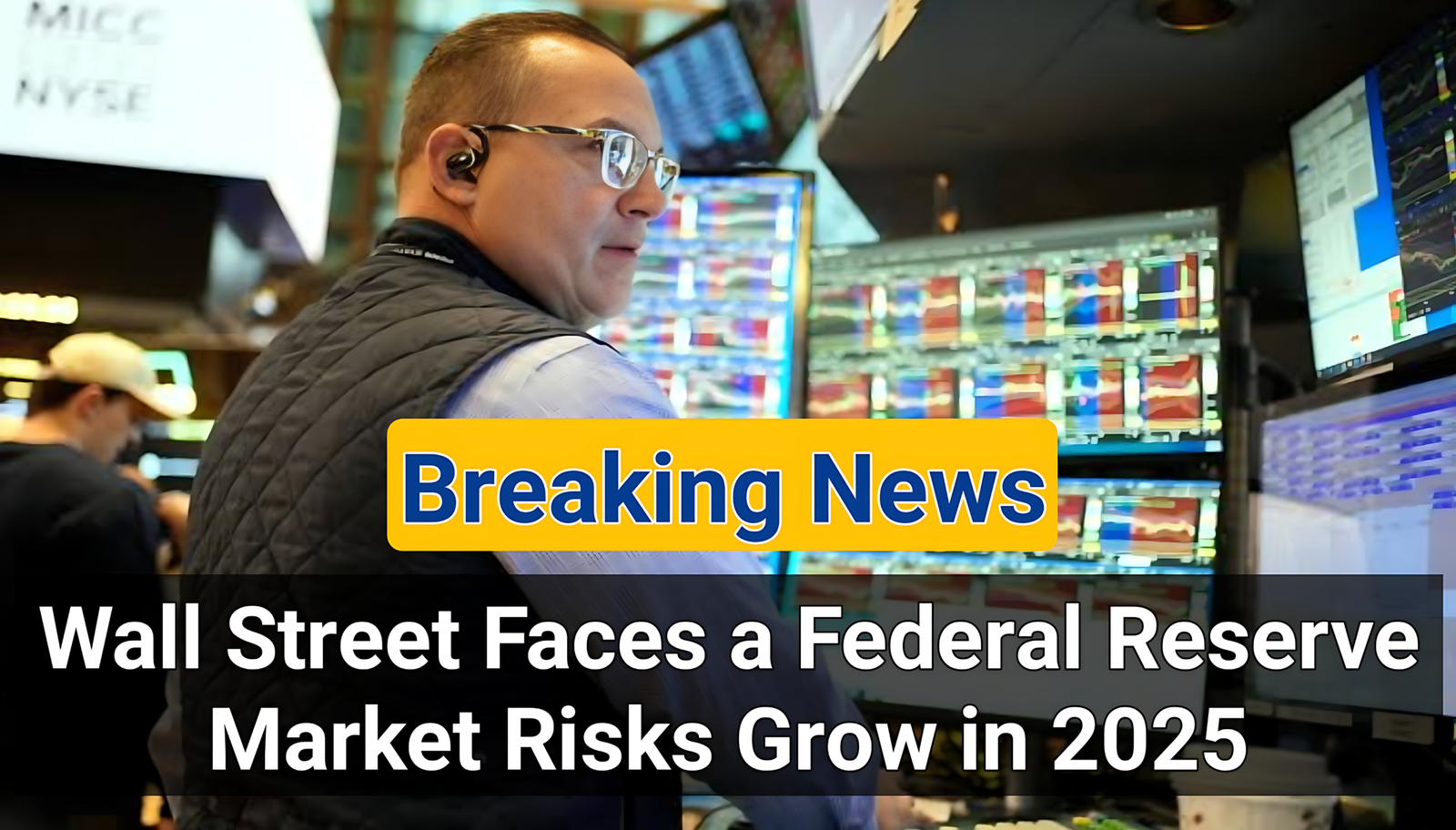
The Wall Street Faces a Federal Reserve Storm in 2026, Wall Street volatility, and stock market risks are becoming hot topics for investors around the world. After years of strong market gains, warning signs are now appearing. The S&P 500, Dow Jones, and Nasdaq have all touched record highs, but history shows that such rallies rarely move in a straight line. As 2026 approaches, many analysts believe the calm may not last for long.
Table of Contents
Why the Federal Reserve Matters So Much to Wall Street
The US Federal Reserve plays a key role in shaping the stock market. Its main job is simple on paper: control inflation and support employment. In reality, it is far more complicated.
The Federal Open Market Committee (FOMC), led by Fed Chair Jerome Powell, adjusts interest rates to guide the economy. When rates go up, borrowing becomes expensive. When rates fall, spending usually increases. Investors closely watch these decisions because even small changes can move markets sharply. What makes 2026 different is not just policy decisions, but deep divisions inside the Fed itself.
A Divided Federal Reserve Is Shaking Investor Confidence
In recent meetings, the FOMC has shown unusual disagreement. Some members want rate cuts, others want no change, and a few even support rate hikes. This level of disagreement is rare in modern history.
Recent Warning Signs Inside the Fed
| Issue | Why It Matters |
| Conflicting rate views | Creates uncertainty for investors |
| Opposite dissents | Signals lack of clear direction |
| Policy confusion | Weakens market confidence |
When the central bank sends mixed signals, markets struggle to price risk correctly. Investors prefer clarity, even if the news is bad.
Jerome Powell’s Exit Adds More Uncertainty in 2026
Another major concern is Jerome Powell’s term ending in May 2026. Leadership changes at the Federal Reserve often make markets nervous, especially when the replacement is unknown.
No one yet knows who will take over or what their policy style will be. Will the next chair be aggressive on inflation? More market-friendly? Or unpredictable? This uncertainty adds another layer of risk for Wall Street.
Rate Cuts and Market Crashes: History Sends a Warning
Many people think interest rate cuts are good for stocks, but history tells a more complex story. In past decades, rate cuts often happened just before or during major market downturns.
Cycles
| Rate Cut Period | Market Outcome |
| 2001 Dot-com era | Long market crash followed |
| 2007 Financial crisis | Severe global recession |
| 2019 Pre-COVID | Sharp crash in early 2020 |
The pattern is clear. The Fed usually cuts rates when it sees economic trouble ahead. That is why investors are nervous about a possible perfect storm in 2026.
Why 2026 Could Be a Volatile Year for Stocks
Right now, markets are priced for near-perfect conditions. Corporate profits, employment, and consumer spending all need to stay strong. Any shock—policy mistakes, economic slowdown, or political tension—could trigger sharp swings.
This does not mean a crash is guaranteed. But it does mean volatility risk is high, especially for short-term investors.
Final Thoughts
Wall Street has enjoyed a powerful run, but 2026 is shaping up to be a challenging year. A divided Federal Reserve, leadership change, and risky rate-cut history create a situation investors cannot ignore. Long-term investing still works, but caution, patience, and smart diversification may matter more than ever.
FAQs
Is a stock market crash certain in 2026?
No, nothing is guaranteed. However, risks are clearly higher compared to previous years.
Why is the Federal Reserve division a big issue?
Because mixed signals make it hard for investors to plan and price risk properly.
Should investors exit the market now?
Not necessarily. Long-term investors may stay invested but should manage risk carefully.
Are rate cuts always bad for stocks?
Not always, but history shows they often come during economic stress.
What is the safest approach for 2026?
Diversification, patience, and avoiding emotional decisions during market swings.